How to avoid overloading an extension cord? Common mistakes and safe usage practices
An extension cord is one of the most used electrical accessories in the home, garage, and workshop. When used correctly, it is completely safe, but improper use can cause the cord to overheat, damage the socket, or even cause a fire.
In practice, we often see that the problem is not with the extension cord itself, but with the fact that too many high-power devices are plugged into it at the same time.
In this article, we look at how to use an extension cord safely and which mistakes you should definitely avoid.
Why does an extension cord overheat?
Every extension cord has a maximum load specified by the manufacturer.
If the total power of the connected devices exceeds this limit, the current will pass through the wire with a higher load than it is designed for.
The consequences may include:
-
the cord heating up;
-
the plug or socket overheating;
-
damage to the contacts;
-
melting of the plastic;
-
electrical failure or fire.
Which devices put the most load on an extension cord?
Home appliances with the highest current consumption include, for example:
-
kettles;
-
fan heaters;
-
electric radiators;
-
irons;
-
fryers;
-
toasters;
-
coffee machines;
-
microwaves.
If several such devices are running simultaneously via one extension cord, the allowed load can be quickly exceeded.
Common mistakes when using an extension cord
1. Several high-power devices on one extension cord
For example, one extension cord may simultaneously have:
-
a kettle;
-
a microwave;
-
a fan heater.
In such a case, the total load can reach several kilowatts, and the extension cord may not be able to handle it safely.
2. Leaving the extension cord coiled
This is one of the most common mistakes.
If the cable remains coiled, heat cannot dissipate sufficiently, and the wire can heat up quickly under a high load.
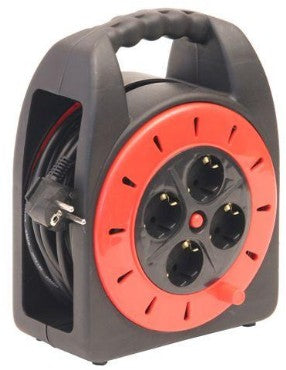
When using high-power devices, the cable reel must always be fully unwound.
3. Connecting extension cords together
Sometimes, people try to connect several extension cords in a row to get more reach.
Each additional connection increases contact resistance and the risk of potential failures.
If a longer connection is needed, it is better to use one high-quality extension cord of sufficient length.
4. Using an extension cord with wire that is too thin
Not all extension cords are the same.
For a higher load, you should choose a cable with a sufficient cross-section and check the maximum load specified by the manufacturer.
Cheap extension cords with thin wires may not be suitable for high-power devices.
5. Continuing to use an overheating extension cord
If you notice that:
-
the plug is getting hot;
-
the socket is overheating;
-
the cable is warmer than usual;
-
you smell burning plastic,
you must stop using it immediately and find the cause.
These are clear signs that the electrical connection is no longer operating safely.
How to use an extension cord safely?
To ensure electrical safety, it is worth following a few simple principles.
-
Check the maximum load of the extension cord.
-
Use a high-quality extension cord for high-power devices.
-
Always fully unwind the cable under high load.
-
Avoid connecting multiple extension cords in a row.
-
Check the temperature of plugs and sockets occasionally.
-
Replace a damaged or worn extension cord immediately with a new one.
When is it better to use a wall socket?
Whenever possible, it is wise to connect high-power devices directly to a wall socket.
This reduces the number of connection points and helps prevent contact overheating.
If using an extension cord is still necessary, it must have the appropriate cross-section, rated current, and quality.
Frequently asked questions
Can a kettle be used with an extension cord?
Yes, if the extension cord has a suitable rated current and wire cross-section for it, and no other high-power devices are being used at the same time.
Must a cable reel always be unwound?
Yes. Under higher load, the cable reel must be completely unwound to avoid overheating.
Can multiple extension cords be connected to each other?
This is not recommended. Each additional connection increases contact resistance and the risk of potential failures.
Is a warm extension cord normal?
Slight warming can be normal under high load, but a hot plug, hot socket, or burning smell indicates a problem and use must be discontinued.
Summary
An extension cord is a safe electrical accessory when used correctly and its allowed load is not exceeded.
The biggest problems are caused by operating high-power devices simultaneously, leaving the cable coiled, daisy-chaining extension cords, and using worn connections.
The right extension cord, reasonable load, and regular visual inspection help prevent overheating and ensure the safe use of the electrical installation.